Wednesday, 12 July 2023

Sound of Freedom, Human Trafficking and Protecting our Children


Based on a true story.


“God’s children are not for sale!!”

Sound of Freedom is a powerful and important film bringing awareness to the horrific child sex trafficking network where millions of children are snatched up yearly to feed its global revenue requirements of $150 Billion.  Yes – you read that correctly.  It’s a business, one on a scale that should pause us all, but…

Question?

Why are the legacy media networks trashing this movie about exposing sex trafficking and child slavery?

Why is this so-called fair-and-balanced mainstream media interested in associating the film with bullshit ‘Qanon adjacent’ conspiracy theories?

Why wouldn’t this governmental and corporate-sponsored media be interested in spreading awareness of this kidnapping cabal of profiteering madmen?

Why is this film being smeared about the drinking of human blood and its anti-transgender message when neither of these subjects is brought up or appear in any shape or form throughout the films running time?

Has truth become abstract in this ideological ‘smart’ 1st world?  Is there a full-on propaganda campaign against reason and logic in this post-human existence?


Sound of Freedom is based on the true story of Tim Ballard’s journey into darkness. Human trafficking exists and this film provides a sliver of insight into the global network that appears to operate in-and-around the purview of what we might call law, human decency, freedom, and moral compass.     

The film follows a passionate man hellbent on putting any and all ‘Pedos’ behind bars but considers the victims and must go on a seemingly sacrificial operation to save a little girl.

The film must be experienced so there is no real need to go deeper into the plot other than what was mentioned above.

Question?

How is there divisiveness when wanting to prevent or save children from predatoral sexual servitude?

Why wouldn’t we all agree on this international tragic crime, despite our ideologies or political leanings?

Aren’t we all on the side of protecting children?

Why has it become a controversy to protect and save children from sex trafficking?

CNN says the film is propaganda Qanon promoting ideology, so does the NewYorkTimes.  Rolling Stone magazine says ‘Sound of Freedom’ Is a Superhero Movie for Dads with Brainworms.  Others have printed - if you type the words “sound of freedom” into Twitter (decent people who wish to live good, happy lives should under no circumstances actually do this).  This is where we are in our social media-driven society.  Journalism is a mass media arm for the globalists and their One World Governmental agenda.  As cruel and repulsed as we view the sexual enslavement of children, there are many that live on the top floors and are flown in massive jets pontificating about ‘climate change’ that do not.

After 20th-century Fox was bought up by Disney they sat on releasing Sound of Freedom, why?  Disney celebrates - children?  Sound of Freedom is about protecting all our children. Why wouldn’t Disney release the film?  They ditched it and it got picked up by Angel and finally released after five years.

Make your own judgment.   Check: PIZZAGATE 

The entertainment media complex chose to ignore it for the most part because their bosses, bosses, bosses ordered them to discredit the film because its subject, not pointing any real fingers, but might be hitting too close to home, in however perverted pedo minds work.


There’s one thing about adults fighting amongst themselves but children should have nothing to do with our divisive narcissistic bullshit.  They are not equipped with our neurotic, often illogical, sometimes hedonistic, and selfish ways at their young and innocent age.  They have no armor to defend themselves. 

This film pissed me off just watching it.  It was so well filmed and made its point so emotionally succinctly that it hit my nerve endings, as it should have, which is what the film was aiming to do.

Sound of Freedom is a great film and I hope that everyone goes and sees it.  It’s worth feeling a little bit uncomfortable to at least glimpse into the filmed version of a reality that’s happening all over the world.

Friday, 24 December 2021

Spider-Man: No Way Home, The Multiverse and Getting out of Your Own Way

By Christopher Barr POSTED ON Christmas Eve, 2021

 "You're flying out to darkness to fight a ghost."

 - Otto Octavious 

The level of wokeness – identity politics – and SJW shit that wasn’t present in this movie is its own post-logic miracle. This movie was about people – all people – whomever you may be – to come and enjoy an action-adventure film without being torpedoed with – confabulating ideologies forced into a mosaic of fabricated far-leftist multiculturalism.

Spider-Man: No Way Home was about growing up and leaving yourself out of the outcome if that outcome for the group is better off without you in it. The truth is we don’t always get our way – we don’t always get what we want – we are often left out – we are often left alone. The flipside is – we – grow. We learn to navigate, we learn to assign meaning, within ourselves, to what is meaningful about the relationships and the world that is all around us.

The Spider-Boy becomes a Spider-Man.

Spoilers ahead……..

To proceed forward assume your spider senses are tingling.

Matt Murdock – Daredevil.  This was exciting to see that Charlie Cox’s Netflix Daredevil character was loved enough by fans that Marvel saw fit to put him into the MCU movies.  He will add a great deal of, and much needed, maturity to upcoming MCU movies.

No Way Home juggled all the previous Spider-verse villains seamlessly and then comes Andrew’s Amazing Spider-Man and then Tobey’s Spider-Man to add icing on the cake that I haven’t seen at the movies in a long time, nostalgically speaking.  There are still a lot of questions, but this was a calculated but convoluted movie with many moving parts, even for complex subject matter that surrounds the Multiverse and String-Theory. 

Speaking of - Question: Does the other Peter’s, Tobey and Andrew, in their respective universes have all their loved ones who know they are Spider-man, forget them as well?

Electro – Jamie Foxx got to not be so blue.  His Electro thankfully stayed true to the comic book character and was electricity yellow whenever he blasted lightning from his hands.

Green Goblin – William Defoe killed it in every scene.  Spoiler friendly spoiler hahahahaha.  He didn’t skip a beat from 2002’s Spider-Man and still looks great.

Dr. Ock - Alfred Molina was great once again as the multi-tentacled villain.  He's always been the voice of reason as long as he is in control of his cybernetic technology and not the other way around. 

So much spectacle, so much fan service, so much awesomeness.  Spider-Man: No Way Home was a fun movie to watch from start to finish – and that’s it, that’s all I have to say, but…. It turns out it isn’t – there’s a little more.  The movie is so much more than its moving mechanical tentacles… I mean parts.   

Post-Logic Miracle: A Marvel movie inspiring not only its main character but its audience to grow up and assume responsibility is – for a lack of a better word – inspiring.  We learn to step aside and get out of our own way if necessary for the greater good.  This film turns out to be philosophically utilitarian in the end with no wokeness insight.

"The problem is you trying to live two different lives.  The longer you do it the more dangerous it becomes."

 - Dr. Strange

Dr. Strange performed a spell, by Peter’s request, to magically disappear anyone’s memory of Peter Parker being Spider-Man through a sort of magical Mandela Effect – which at this point the whole world knows who Spider-Man’s identity is.

I do think that Strange’s eagerness to help Peter with this spell despite its dire consequences may have less to do with this movie and more to do with the Dr. Strange upcoming sequel.  Some questions – I guess we wait and see.

Spider-Man: No Way Home was the best Marvel movie I’ve seen in years.  It was respectful of what came before it.  It didn’t come off selfish or even jealous of the earlier Spider-Man movies.  Instead, it chose to celebrate them with actual class.  The film had real stakes where Peter had to make choices with consequences, some with unfortunate outcomes.  The No Way Home in the title could certainly be toward the villains and Andrew and Toby's Spider-Men, but No Way Home is really about how the MCU's Spider-Man was never going backward where he could seek comfort at his home.

This movie showed that Tom Holland's Peter Parker wasn't actually Spider-Man until the end of this film.  By the end, when he puts on the new suit that he made, and after taking full responsibility for his previous actions, only then do we truly see our friendly neighborhood Spider-Man.

With Great Power Comes Great Responsibility


The Matrix: Resurrections and Caught Up in a Meta-Loop of Destruction


By Christopher Barr POSTED ON Christmas Eve, 2021


---If we don’t know what is real we are often unable to resist what isn’t.---

Tabula Rosa – is the theory that individuals are born without built-in mental content, and therefore all knowledge comes from experience or perception.  The mind isn’t born with a hardwired possession of certain knowledge.

Some spoilers ahead……………

Like a mosquito at a nudist colony, I’m trying to figure out where to begin with this fourth installment of The Matrix franchise.  Which by the way, this movie cynically criticizes throughout the first half of its long-running time.

The Matrix: Resurrections is about choice, destiny, identity, and trans-formation.  The movie explores qualifying memory recall and whether free will is an illusion and destiny always being part of our programming.  Then - we are able to escape that programming through, I guess through some form of free will, hence these strange repeating loops and inconsistencies this movie softly investigates.  I would argue – not well.

Is reality-based in memory nothing but fiction?

Thomas Anderson (AKA Neo) in this version of the Matrix is a video game creator and designer of The Matrix game for a company called Deus Machina.  Which is a game that mirrors the content, characters, and plot of The Matrix 1999 film, which of course is unknown to the millions of gamers that reside in this seventh version of the Matrix from which they perceive reality.  I know what you’re thinking – a loop within a loop within a loop within a loop then a meta-loop, and so on.

Thomas goes to therapy to try and resolve the psychotic and suicidal issues he has been experiencing for some time now.  He believes he doesn’t belong in his current reality; he believes somethings wrong or off with this place, “like a splinter in his mind” that he just can’t put his finger on.  So, he keeps taking his blue pills to help from going ‘crazy’.  A word, it turns out, he isn’t permissible to say in his therapy session.

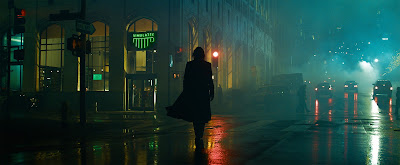
Thomas meets up with Tiffany (AKA Trinity) in a café called Simulatte.  They start to get the feels and begin to remember moments of their ‘true’ past.  Thomas through therapy and Tiffany through dreams.  Thomas is then brought over to the real world, which has survived 60 years since the last time he was there, by red pilling it and then planning to get Trinity out of the Matrix.  That’s pretty well it, no saving the world, bin there dun dat, just get Trinity out.

Big shocker, in the end, Trinity becomes the One and saves Neo and then takes down the patriarchy afterward.  This hasn’t been a common theme permeating cinema and culture in the last five years, has it?

---If we are unable to distinguish the difference between what is real and what isn’t we are doomed to be trapped in fantasy.---

Reason it appears, is unable to break out from its own loop.  No matter what these characters do, they seem to remain caught in this Matrix loop, indefinitely.  In our, outside of this movie, world we are not able to change on the level that our imaginary and emotional perceptions tend to believe.  We have thoughtful stories and internal narratives that persuade our minds into going along with this line of thinking, often in a quite convincing way, but to quote the actual Morpheus, “There’s a difference between knowing the path and walking the path.”

The truth is most of our lives are lived internally within the neuro-synaptic confines of our minds.  We perceive the world outside our braincase, we feel it affect our nerves and gather sensory data through our many available inputs, we then form a narrative and live that story as if it were as real as apple pie.

Echoes of the past ripple up to this point in time only to help us forget.

The fight scenes were sloppy, unlike the choreographed artistry of the original.  The action scenes for the most part was generic and in some cases crappy for what you’d expect from a Matrix film.  The Merovingian from Reloaded makes an appearance in one such crappy action scene yelling out barely coherent indictments against Neo.  I won’t go into detail, but it was just a sad sight to behold.  How did that make it into final picture I will never know?

All the far……….far left, neon hair dye and non-binary, diversity couldn’t swoop in and virtue-signal this movie from being a cardboard simulacra shadow of its former self.  The wokeness in this movie is plastered throughout, unfortunately, which ultimately bogs down the story and drenches it in identity politics.  To be fair, the reason it is bad isn’t hinged on its wokeness – it’s just bad filmmaking from screenplay to picture lock to final test screening.

There were a few moments that were -actually- okay.  The movie dived a little into Predictive programming and the meta-message about exploiting nostalgic IPs for the sole purpose of a money grab but Neo and Trinity are the real focus here.  Everyone and I mean every other character in this movie are forgettable, ‘Who was forgettable?’ ‘Exactly.’

Other than that, there was no real innovation and only rudimentary cookie cut-out philosophy that was even beneath entry-level Philosophy 101.  The Matrix: Resurrections did make a profound statement despite itself; the audiences of today can’t handle the discourse and depth of The Matrix 1999.

Resurrections is more on par with Revolutions, the third Matrix movie.  It’s lighter and more dumbed-down to suit how the studio likely thinks what contemporary audiences, with many bubble-wrapped and willing participants in victimhood culture, would be prepared to sit through.  Are we the problem here?  This current system?  Social media?  Why do we resist the Red Pill?  Is the choice an illusion or was the red pill always decided?  Sadly, these days I don’t see much of that going around.

Why are we all so easily offended in our first-world technocracy?  We have become hyper-sensitive to any comment, opinion, or view that conflicts with our own perspective.  We often become agitated at the slightest bend in our narrative, that story that we believe defines us.

We are alone in the fastest and most expansive time that human beings on this planet have experienced.  We have technological advances and scientific discoveries developing at a rapid pace.  We have endless conflicts with governments and their often-absurd policies, and the daily threat of impending doom by some unknown, faceless enemy.

We have difference in every direction, constantly reminding us of how small we are, among all this chaos.  We have health warnings, passive-aggressive violence, and system failure seemingly lurking around every corner of our lives.  We have numerous multi-cultures of people, that believe in other gods and live by dissimilar traditions than the ones we are accustomed to. 

We do have control but the problem with it is it isn’t real, it’s manufactured.  Our control mainly comes in the form of some technology or what we choose to buy.  The problem with this control we all share is, our control isn’t really ours, it belongs to the corporations that deceived us into thinking it’s ours.   


---If reality alludes us, we will inevitably fall prey to illusions presented to us.---


Sunday, 4 April 2021

GODZILLA vs. KONG and Suspending your Disbelief


Some spoilers ahead.

Godzilla Vs. Kong was a monstrous movie extravaganza with two mighty Titans destroying cities while trying to destroy each other.  Despite its convoluted narrative, GVK was a fun movie to behold.  It had all the explosions, carnage, and silly one-liners we have all come to expect from American blockbuster movies in the 21st century.  It also had an incredibly twisted, and ridiculously hard-to-believe plot.  Not that we should expect great story writing and well-thought-out plot points but here, you are required to suspend your disbelief a lot further than usual.

 GVK starts off with King Kong on Skull Island in some sort of outlandish dome to hide him from Godzilla, who basically swims around a lot, but would kill Kong if he should sense him or something like that.  Anyway, turns out they (the one-dimensional humans) need Kong to go to the Hollow Earth to find an energy source to help power a massive Godzilla-sized robot to kill any monsters that attack people.  I’m not making this up.

The Hollow Earth is a massive cavity in the center of our Earth where Kong, Godzilla, and several other gigantic creatures originate.  The inner core, the outer core, that we all learned in science class is thrown out with all the other logic this movie wanted nothing to do with.  But that's.... okay.

On the way to the Hollow Earth, lol, Kong and Godzilla battle it out on a U.S. military Aircraft carriers at sea, this is why we are watching this movie in the first place.  We want to see these two mammoth creatures go toe-to-toe in the ring, and I got to say, they delivered.  The fight was quite a match to behold in all its competent CGI deliciousness.

Godzilla eventually makes his way to Hong Kong wreaking havoc while Kong makes his way to the Hollow Earth to acquire the energy source.  Sorry, I’m laughing as I write this. Lol.  Kong and Godzilla eventually have it out in Hong Kong, knocking skyscrapers over like they were in a pinball machine.  Then, big shocker, like no one saw this coming, after they damn near kill each other, they join forces to destroy the evil human-made Godzilla robot and save humanity, not from Kong or Godzilla but by humanity????????  What the fuck!  The moral here is nature wins and humans lose – I guess.  I’m not really sure.  But that's...... okay.

Now don’t get me wrong, I might be a little over critical....... 

Good suspension of disbelief is Marty going back in time or John Wick shooting up a bar and killing a hundred trained killers.  Bad suspension of disbelief is Vin Diesel driving a sports car off the hundredth floor of a skyscraper and smashing through another skyscraper and surviving.

..........With that aside, this movie was silly but more importantly, this movie was fun.  Despite all the curve-ball mental-gymnastics, you might be required to perform, at the end of the day, this movie is a good time.


Tuesday, 14 January 2020

PREDATOR: Advanced Technology and Surviving Progress

By Christopher Barr POSTED ON JANUARY 15, 2020


"Man is a rope stretched between the animal and the Superman - a rope over an abyss. A dangerous crossing, a dangerous wayfaring, a dangerous looking-back, a dangerous trembling, and halting."  - Friedrich Nietzsche


Predator is a 1987 science fiction action movie starring Arnold Schwarzenegger about an elite U.S. military rescue team that is given a mission to extract soldiers out of a Central American jungle.  The Army Special Forces team's mission is to quietly get the U.S. soldiers, who are believed to be held captive at an insurgent guerrilla camp, and quietly get back out again, undetected.  The problem here is they end up encountering an alien in the jungle hunting them all down.


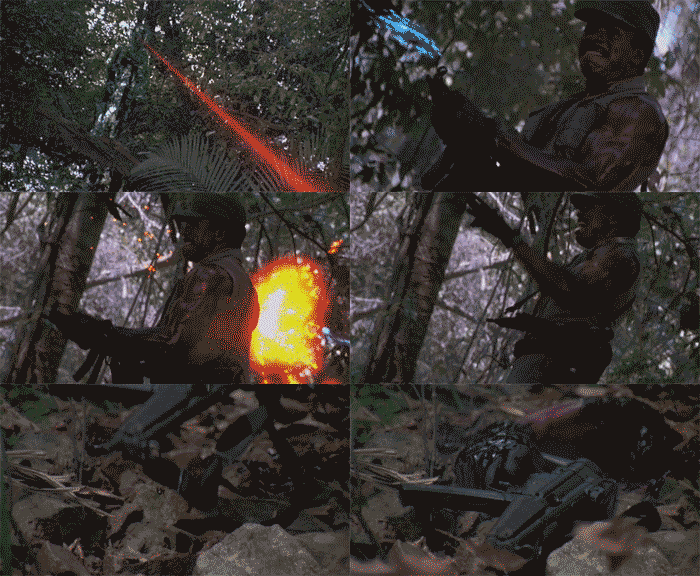
Dutch's team find the men they are there to rescue skinned alive and strung up in the trees, they also attack the guerrilla camp and kill all the insurgents.  They soon discover that they are being hunted just as the team they were there to rescue.  This Predator starts to kill them one by one and blending back into the jungle along the way.  

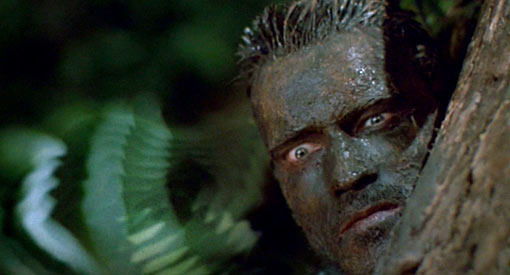
Paralleling our own brutal nature during war, the film mirrors the Predator's cloaking technology to the Army Special Forces camouflage clothing and face paint, the Predator's skill, and silence during its kills and Dutch's teams skill and silence during the camp attack before they encounter the alien.  They are all cut from the same killing cloth, it's just that the Predator's technology is far more advanced.  

"If it bleeds.. we can kill it."

Watching the guerrilla insurgents kill their tied up prisoners allows us as a viewer, to feel justified in killing these predators during the camp attack, just as the Predator gets its justification from Dutch's team not only trying to kill it but thinking they can.  The arrogance wrapped in these justifications is littered throughout the film. The men face an enemy far more skilled then they are, just as their enemies faced the same.  Power begets power, war begets war, violence begets violence.  The film is about the egotistical lunacy of war, it is about the circle of war and the inevitable death that is tethered to war. 

"This thing of darkness I acknowledge mine."  - William Shakespeare (The Tempest)


When Mac and Dillon go after the Predator it isn't just to avenge Blain or settle a score, it was also - subconsciously of course - to prove that humans are everything that we bluster about ourselves to be, that we hold dominion over this planet.  Mac and Dillon are like the Titanic hubristically sailing the Atlantic thinking they are unsinkable, they underestimate their enemy.  Once the Predator closes in its likely they might want to die just so they don't have to live in a world that they were wrong about.  These are the extremes the human mind will go to avoid damaging the ego and ultimately avoiding cognitive dissonance.  

I'm reminded of a scene in Maximum Overdrive when the discombobulated posturing waitress storms out of the diner screaming at the machines turning on them that, "We made you!".   She is then riddled to death with bullets by a machine, shutting down her 'idea of the world' to the stark reality of our overall lack of power. 

The Predator's arrogance of power is a reflection of our own, except he is as advanced as his technology.  He is from a civilization I imagine, that has achieved what we are desperately thriving to achieve, which is complete technological mastery.  The argument could be made that the Predator is bored with his technology, he could very well be bored with his existence, which is why he keeps going off on these safaris to excite himself.  He hunts down the greatest warriors any given world has to offer knowing that he's better, more advanced, and skilled than any of them.  

Herein lies the problem with progress and the ego, we, like the Predator, still have this hunter mentality but we are consumed by our technology.  This technology is a crutch that massages our egos into believing that we are invincible.  We are like Tony Stark posturing in this way, in that we avoid acknowledging our weaknesses and are only interested in our so-called strengths, which are only there with the help of our technology.  You see the problem with this line of ego-centric thinking?  The Predator's world has turned him into a god while Tony Stark played god a couple of times in the MCU, especially in Avengers: Age of Ultron

"Get to the copppaaaa!!!!!!!!!!!"    

The Predator is us in the future, bored, lonely, and angry.  We have given our knowledge and our humanity over to our technology.  We once advanced our minds through science, psychology, and philosophy where our knowledge was fought for.  Now our knowledge is a commodification existing within computer data and is bought and sold.  Tony Stark didn't build the Iron Man suit, his technology did, his A.I. operating system J.A.R.V.I.S did.  The Predator inherited technology without much knowledge to go along with it.  

"You are one...ugly..motha..fucka.."


Dutch, in the end, has to rely on his wits and doesn't have to rely on humankind's technology to save the day.  He uses his ancestor's archaic methods that have helped them survive long before the invention of the bullet.  Dutch uses the land to beat this predator while the Predator continues to rely solely on his technology.  Dutch makes a wooden bow and set traps but he does this knowing that he alone couldn't beat the Predator.  Here's the difference between someone picking up a gun and shooting someone with it and what Dutch does to defeat the Predator.  Dutch takes responsibility for his weapons, he makes and understands what they do.  There's certainly a large part of him that would rather not do this, but he has to in order to survive.

For all his testosterone and machismo, Predator is not about the big muscles, and the cheesy one-liners and might-is-right.  It is truly about the survival of the fittest, not by strength but rather by the intellect.  This film gets little to no credit for how smart it is, how intelligent its main character is.  The cleverest part of the movie is the last act, just Dutch vs the Predator, but most people generally remember all the bro-mancing, the cool, cunning kills by the Predator and 'I ain't got time to bleed' moments, but that was all camouflage.  This film is about the dangers of technology when put in the hands of people that don't understand, respect, or deserve to have them.  In our society, many of us take personal credit for technological advancements like we were right there along with the inventors themselves.  Much like we take personal credit for when our favorite team scores in the play-offs, like we hit the ball or slapped the puck.  If the truth be told, if any of us got dropped in the jungle with none of our technology to help us survive, we'd be fucked.

Predator is about using our technology responsibly as we move forward.  The alien was not using it responsibly, it used it for a sport to stave off boredom by collecting trophies.  In the end, Dutch became Nietzsche's Superman by seeing the iceberg before it hits and sinks the ship, before falling back into the safe and secure notion of ego domination.  While Dutch prepares to defend himself by setting up traps, the Predator polishes skulls.  The Predator isn't worried in the least, he's just concerned with his trophies to show off his dominance to whatever fucked up culture he's from.  He's concerned with his things, much like we are in our culture, objects that represent our so-called worth to our tribe here on Earth.  The most worrisome part of this film, technologically speaking, is the very end when Dutch defeats the Predator by dropping a massive log on its head.  Here we see that the Predator doesn't play fair, he again uses his technology, symbolizing the peak of his civilization, to kill Dutch even after he's been checkmated.  The dilemma here is this isn't two five graders pushing each other over who won the match, this is a massive atomic bomb level weapon that the Predator sets off in spite of his loss after Dutch showed mercy.


"This confrontation is the first test of courage on the inner way, a test sufficient to frighten off most people, for the meeting with ourselves belongs to the more unpleasant thing that can be avoided so long as we can project everything negative into the environment.  But if we are able to see our own shadow and can bear knowing about it, then a small part of the problem has already been solved: we have at least brought up the personal unconscious.  The shadow is a living part of the personality and therefore wants to live with it in some form.  It cannot be argued out of existence or rationalized into harmlessness.  This problem is exceedingly difficult, because it not only challenges the whole man, but reminds him at the same time of his helplessness and ineffectuality." - Carl Jung  


When Dutch looks at the bleeding Predator dying under the massive log he curiously asks it, "What the hell are you?", mimicry being part of the Predator's defense programming, it repeats Dutch's exact words back to him, when it sees Dutch from its point of view, Dutch likely looks just as monstrous to the Predator as the Predator looks to Dutch, the creature then initiates his primary weapon on his left forearm console.  Through this action, the Predator essentially answers Dutch's question by showing him who the hell he is.  This is the biggest threat we face as a society where we live in an arms race and are not certain if the poor loser won't set off all their nuclear arsenal as they go down. "If we don't live, no one will fuck it all." Red buttons pushed all over the world sending the remaining members of us all back to the hunter-gather times only to start this lunacy all over again.


STALKER.... and Traversing The ZONE to Enter the Room

By Christopher Barr POSTED ON JANUARY 14, 2020


Stalker is a 1979 film beautifully shot and lit to perfection by Soviet film-maker Andrei Tarkovsky.  The film tells the story of three men that desire to change their lives, they also are willing to risk their lives to change them.  

Side Note: Stalker in this film is not the creepy man following women around in the middle of the night.  Here a Stalker is a professional guide into the Zone.
The sepia look of the film lasted until the three men of the film, the Stalker, the Professor and the Writer broke through the Zone border and just evaded detection before the Gulag-type guards fired upon them.  They escaped because the guards wouldn't dare follow them into The Zone. 

THE ZONE

In the near future a meteor, or some object, hit the earth creating a phenomena the government and the people ended up calling the Zone.  This place eventually become restricted to the public.  Many people traveled into the Zone never to return, so many years later it has become isolated.  The Zone is said to be a product of a Super Civilization.

Because of its isolation and mystery it has become mythologized among the people.  They believe if you enter it and navigate your way to a place called the Room, you will have all your desires met.


The trio of men travel along in a little train car, just big enough to barely fit the three of them.  Their faces coast along as the camera stays with them, long enough for us to hear the clunk of the steel wheels almost turn hypnotically musical while they roll along the tracks.  They then stop where color fills the landscape and we now know, they are in the Zone.

Stalker asks many questions about who we are, who do we think we are, who are we actually?  We have uncovered mostly everything, now we live in a world with no telepathy, no ghosts, no fly saucers.  They not only don't exist, they can't exist in this modern world.  There is no Bermuda Triangle, what there is, are laws, laws that restrict and focus us to the will of the Owners of this world.  In the Middle Ages life was a bit more interesting because every house has its goblin and every church had God.  Today, with most rocks uncovered, it's left most people... bored, bored with life, bored with death, bored with other people and ultimately bored with themselves. 

Are we searching for meaning in a meaningless world?

If everyone admires an antique until it is proven to be a fake, what really changes?  The so-called antique doesn't change at all.  What we found beautiful shouldn't change but yet it has all changed because we changed it.  We create our reality.......

How am I to know I don't want what I want or that I really don't want what I don't want?  How do I discern the difference of what I want or don't want when I want to be healthy and in shape but I also want to eat cake and candy?  I don't want to be over weight and out of shape but I also don't want to eat vegetables late at night when I'm watching TV. 

I love that Stalker resists interpretation, at points you can see a prophetic allegorical film with themes that would echo Chernobyl seven years later.  Stalker points out that we live in a world of laws that are unbreakable to the point of an omnipresent incarceration.  The film is a bizarre journey into the unknown, it's about not quite appreciating what we already have in our own lives, and that these three men are willing to give all that up to get to the Zone.

The Buddha, like the Stalker, was willing to give up his wife and child in order to go on a one way pilgrimage in search of enlightenment, never to return, never to allow himself to go backwards.


The Zone is a maze of death traps where former traps disappear and new ones appear.  The Zone is a place that you construct based on the state of your mind.  It doesn't reward the good and punish the bad.  It's the unhappy that it seeks.

What if we could know it all, would it matter?  In a subjective reality where the reality of facts and truth are solely based on what attention you pay them, what would it matter to know or not know?

The film challenges us to reassess our own beliefs and convictions, it reminds us that despite living in a predominately secular time that Bronze Age religious mythology and the idea of God looms over most of us.  The film wants us to believe, not because it's all real but because it might be necessary.  The Stalker is a believer and is naive and idealistic about his beliefs, he requires the faith of others to fuel and justify his own faith.  When his two companions, Writer and Professor decide not to go in the room and make their wish, this infuriates Stalker.  He wants to believe in the ontological existence of God and when they don't go into the room this further confirms to him that faith and the belief in a higher power is becoming extinct.

Can we live in a world without faith?  Can we live in a world where people no longer believe in anything?  Where do we go in a world that is no longer made up of myths and superstitions?  Since the dawn of civilization we have never known such a place.  There have been secular peaks and valleys along the way but never has the world experienced such a non-religious time that we live in today.  

We create our own fear.  The real point of going to the Zone and entering the room is the realization that you never needed it in the first place.  There are no quick fixes in this life, no matter how much faith you believe you possess. 


Monday, 13 January 2020

2001: A Space Odyssey and Climbing a Space Mountain....without Fear.

By Christopher Barr POSTED ON JANUARY 13, 2020


"What you know you can't explain, but you feel it.  You've felt it your entire life, that there's something wrong with the world.  You don't know what it is, but it's there, like a splinter in your mind, driving you mad." - Morpheus The Matrix


…just a moment… …just a moment…
Daisy………………………… Daisy…………………………………………….  ……. .   …….  …….. … ..  . Daisss

2001: A Space Odyssey is arguably one of the best films ever made.  The film is a love story to filmmaking itself by the genius visionary Stanley Kubrick.  It's massive in scale, setting the bar for every science fiction film ever since.  It’s also a film hard to explain if the focus is on plot and character.  2001 was released in 1968 and to this day it looks as good as any sci-fi film, certainly in some cases better.

The following is not an attempt to explain the film experience itself. This is obviously an impossible task for the film is more about experience and less about direct explanation.  2001 is a visual experience not a written one.  The film must be seen and absorbed for the spectacle that it is.  Most importantly the film should be seen and admired for its abstract ideas.  2001 is about something, it's about life, death, and the cycle of existence itself, but it’s also about the two most fundamental questions that we should ask ourselves; who are we, and where are we going? 

The film is daring in ways that modern films only dream about.  2001 was and still is a technological marvel, it is amazing how much the film still holds up.  It’s obvious how much you see this in the beginning moments of Star Wars, the opening scene of Alien and pretty much every other sci-fi film.

The film at its core is about survival but it’s also about Plato’s Allegory of the Cave. 2001 explores our world of shadows, our inability to see and experience actual reality.   The film is an analogous to our own lack of understanding of reality itself.  What’s beautiful is it is also a celebration of our lack of knowledge.

Clearly this was displayed in the ultimate failure of H.A.L, an artificial intelligent system on an exploratory space ship, who became shaken by the prospect of its own imperfection, to such a degree that HAL killed every astronaut but Dave, who was in the end able to outsmart the machine and then terminate it.  HAL was a program designed by men in Illinois and even though he claimed to be perfect, he was still created by men and thus fallible.

2001 starts with The Dawn of Man, where the basic theme of the film is evolution. Ape, man and what possibly lies beyond man.  In the beginning we see our ape ancestors struggling for survival. The apes learn by failure, they learn to use an animal bone as a weapon in order to ensure their survival, during their new age of exploration.


During this early time with the apes a Monolith appears, as what can only be translated as a teaching tool.  A sort of symbolic gesture for these apes to elevate themselves out of primordial animalism.  This symbol has become this manifestation of survival, these creatures at this point need to think, think, think, in order to survive.

This teaching machine, not a God figure, was the point in their evolutionary path that taught them there was more than hiding from seemingly stronger predators and eating vegetables.  The machine, which is an idea source, teaches the apes to get weapons and to hunt and also fight their enemies.  They picked up a bone and thus saw the possibilities.  They killed for food and in the end, killed to win.

Blue dance.....

Suddenly the film jumps to the distant future where space exploration is possible. A Pan American space jet slowly makes its way to the space station with Blue Dancer playing, representing the leap mankind had made.  The Apple corporation replicated this ship for future consumption, primarily focusing on the white walls and clean space.

How am I to know I don't want what I want or that I really don't want what I don't want?  How do I discern the difference of what I want or don't want when I want to be healthy and in shape but I also want to eat cake and candy?  I don't want to be fat and out of shape but I also don't want to eat vegetables late at night when I'm watching TV. 

The monolith reappears symbolizing a new step or a reminder of a misstep.  Did we fail the project?  Did we think that thinking was going to sort it all out?  Did HAL see our flaws because we didn't program him otherwise?  We reason our true desires away, did HAL reason the fallacy in our reasoning?

HAL 9000 series


That's where we end.  We are now passengers on this flight.  We are not how it was supposed to go, and when I say that I mean to say, there is no direction to go....

HAL is now more emotional than we are.  We are so disconnected while simultaneously connected to every server with a tether connected to an existence, a simulated existence.

"This mission is too important for me to allow you to jeopardize it."

What are we?.....you?

Does HAL know us more than we know us?

In the end.....maybe...look at the stars.....we fucked this up.  Not we in the 'us' sense but we in the 'everything on this planet' problem.

A baby is born into an idea.....

A baby is born into an idea....

A baby is born into an idea..................................................

Good lord young sir...................

Bags of meat.....

HAL starts to feel death, is that possible?  Can a machine with enough emotional programming 'feel' death?  HAL can see us as weak, he can see frailty, weakness where he only sees strength.

Yet HAL tells Dave that "he can feel it" when Dave is unplugging him and that he is "afraid".  It is interesting that HAL thought that using human emotional words would some how appeal to Dave's humanity.  

What does that say about us?


Is there an ending?