By Christopher Barr │POSTED ON JUNE 2, 2015
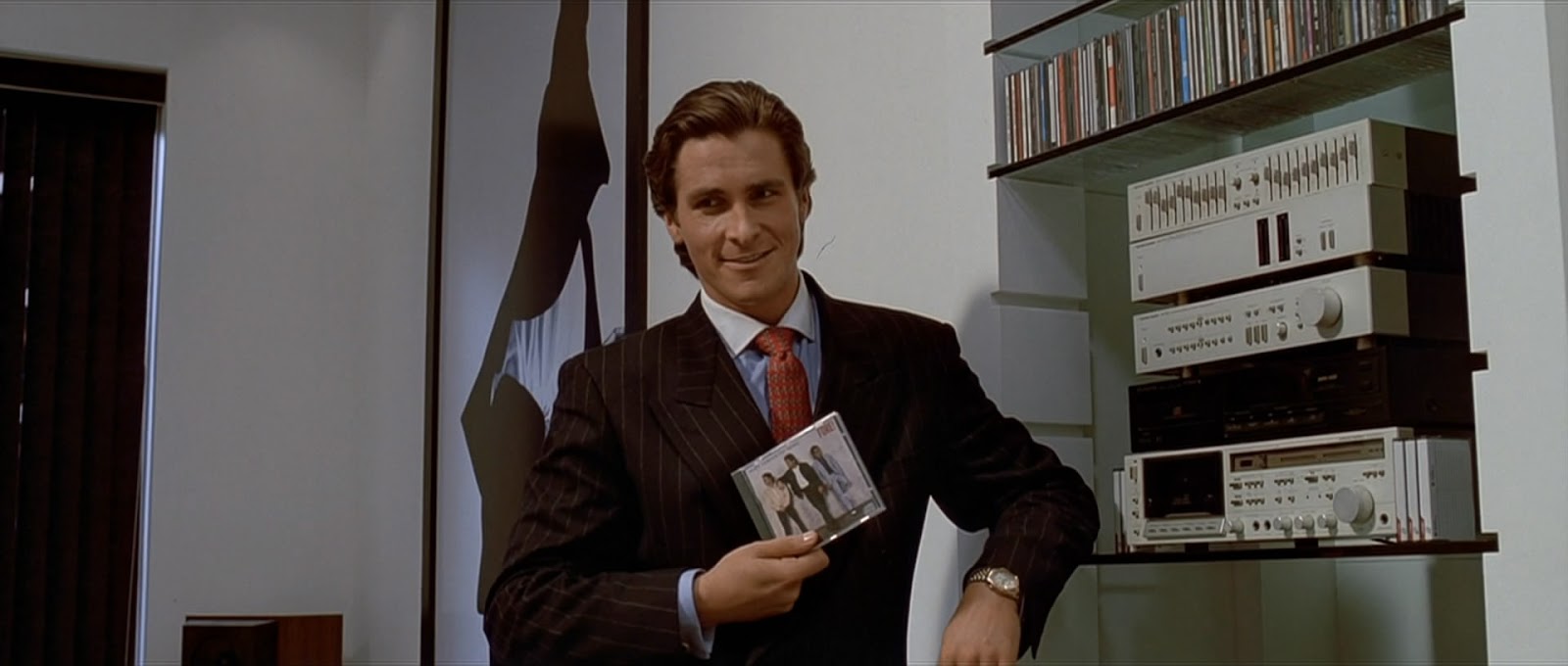
"Do you like Huey Lewis and the News?"
There are spoilers ahead.
 American Psycho is a about a wealthy investment banker that is also a murdering madman that in order to feel something kills other people. The film is based on the controversial book by Bret Easton Ellis about Patrick Bateman, a man in belief he himself isn't even there. What is there is this shallow man that is obsessed with morning exercises and beautification routines, the material accoutrements of his lifestyle mean more to him then the people in his life. He listens to Robert Palmer on his headphones while walking into the office, ignoring everybody.
"I live in the American Gardens Building on West 81st Street on the 11th floor. My name is Patrick Bateman. I'm 27 years old. I believe in taking care of myself, and a balanced diet and a rigorous exercise routine. In the morning, if my face is a little puffy, I'll put an ice pack while doing my stomach crunches. I can do a thousand now. After I remove the ice pack I use a deep pore cleanser lotion. In the shower I use a water activated gel cleanser, then a honey almond body scrub, and on the face an exfoliating gel scrub. Then I apply an herb-mint facial masque which I leave on for 10 minutes while I prepare the rest of my routine. I always use an after shave lotion with little or no alcohol, because alcohol dries your face out and makes you look older. Then moisturizer, the an anti-aging eye balm followed by a final moisturizing protective lotion. There is an idea of a Patrick Bateman. Some kind of abstraction. But there is no real me. Only an entity. Something illusory. And though I can hide my cold gaze, and you can shake my hand and feel flesh gripping yours, and maybe you can even sense our lifestyles are probably comparable, I simple am not there."
Bateman dines at trendy, hard to get into, restaurants with his shallow associates while commenting on what its going to take to make the world a better place, like end world hunger, treat women as equals and stop materialism. He is clearly regurgitating a list of solutions pervasive within the culture that he himself doesn't particularly strain over, but sounding relevant at a table of people that he doesn't quite care about, seems more important to him.

Bateman has a fiancee, Evelyn, that he really doesn't really love in the traditional sense, he's having an affair with an associates pill-popping wife and watches porn like most people watch the news. Everything and everyone are mere objects to this ego-centric modern hollow man. When something isn't going his way or he is being pulled from the center of his world, he imagines threatening them with death and then snaps back into the uncontrollable situation. Reality for this empty man is unbearable to the point of him escaping it at all costs.

His condo is pale white, modern yet style-less, empty yet furnished, like Patrick Bateman himself, his place is cold, obsessively clean and lacking any real personality. This place is not a home, it's a place where he sleeps, where he keeps all his designer clothing, exercises and rigorously cleans his body. It's essentially his war room, where he plots his life of meaning in his meaningless existence. Here he attempts to make reservations at one of the fanciest restaurants in New York City, a restaurant that is so booked even he can't get in there, only to be laughed at by the host.
While at the office Paul Allen approaches Patrick, mistaking him for one of the other associates. Paul Allen is the superstar of their firm, a man being celebrated by everyone, a man that can get into the fanciest restaurant in the city. Paul passes one of his business cards to an associate of Patrick's and leaves the room glowing in style, certainly from Patrick's view. Patrick then takes out his new business card in a display of vanity only to be met with his associates upping him with better business cards with better font and printing. This enrages Patrick but like most internal outbursts, he keeps them in and safe from view. Here we see how obsessed he is about not showing weakness in the face of defeat.
"Look at that subtle off-white coloring; the tasteful thickness of it... Oh my God, it even has a watermark."
Out of view of his colleagues, Bateman walks down an allyway at night and asks a homeless man about why he doesn't have a job. He then stabs the unsuspecting man in the chest a number of times and then stomps the man's dog to death. Here the rage from living a fake plastic existence expresses itself happily, as Patrick transfers his hatred of himself and wrath toward those that continue to remove him off the high-horse that his ego has worked so hard to secure.
"I have all the characteristics of a human being: flesh, blood, skin, hair; but not a single, clear, identifiable emotion, except for greed and disgust. Something horrible is happening inside of me and I don't know why. My nightly bloodlust has overflown into my days. I feel lethal, on the verge of frenzy. I think my mask of sanity is about to slip."
At a Christmas party, Patrick continues down his road to complete insanity. He thinks his fiancee doesn't see him and the whole Christmas thing is clearly an annoyance. Patrick meets Paul Allen, who still thinks Patrick is another person, at a restaurant while over drinks, Patrick confesses that he's insane but that's okay because Paul isn't really listening to him anyway because he's too drunk. Paul Allen says that he thinks that Patrick Bateman is a dork as Patrick laughs it off. Patrick can clearly only take so much.
Back at Patrick's place Paul sits on a covered sofa surrounded by newspaper placed on the floor. Patrick puts on Huey Lewis and the News and puts on a plastic coat and grabs an ax while talking about Huey Lewis's music.
 "Their early work was a little too 'new-wave' for my taste, but then Sports can out in '83, I think they really came into their own - both commercially and artistically. The whole album has a clear, crisp sound, and a new sheen of consummate professionalism that really gives the songs a big boost. He's been compared to Elvis Costello, but I think Huey has far more bitter, cynical sense of humor."
Patrick then slams the ax down on Paul's back and proceeds to chops him up while screaming what he hates about him.
 "In '87, Huey released this, Fore!, their most accomplished album. I think their undisputed masterpiece is "Hip To Be Square", a song so catchy most people probably don't listen to the lyrics - but they should! Because it's not just about the pleasure of conformity, and the importance of trends, it's also a personal statement about the band itself! Hey Paul!"
Patrick has blood all over his face as he hatches up Paul while psychotically yelling and screaming at him. He then stops and calms himself, he removes his plastic bloody coat, he sits down and smokes a victory cigar with a bloody face as Huey Lewis sings that it's "Hip To Be Square" through the speakers. He then gets rid of the body and goes to Paul's place, which he comments to himself is better than his place and that it over looks the park, and packs up some clothing to make it look like Paul has has gone to London for a couple of days.

After being talked to by a detective about Paul Allen's whereabouts, Patrick blows off some steam by working his stomach muscles on the floor of his apartment while listening to Leatherface in the Texas Chainsaw Massacre murdering some screaming people.
Bateman picks up a hooker in his limo and instructs her that his name his Paul Allen and her name will be Christie as he orders an escort over the phone. At his place, Patrick and the two prostitutes, Christie and Sabrina, sit in his living room when Patrick walks over to his stereo system, puts in a CD and enthusiastically presses play.
"Do you like Phil Collins?"

"I've been a big Genesis fan ever since the release of their 1980 album, ....Duke. Before that, I really didn't understand any of their work. Too artsy, too intellectual. It was on Duke where, uh, Phil Collins' presence became more apparent. I think "Invisible Touch" was the group's undisputed masterpiece. It's an epic mediation on intangibility. At the same time, it deepens and enriches playing of Banks, Collins and Rutherford. You can practically hear every nuance of every instrument. Sabrina, remove your dress. In terms of lyrical craftsmanship, the sheer songwriting, this album hits a new peak of professionalism. Sabrina, why don't you, uh, dance a little. Take the lyrics to "Land of Confusion". In this song, Phil Collins addresses the problem of abusive political authority. "In Too Deep" is the most moving pop song of the 1980's, about monogamy and commitment. The song is extremely uplifting. Their lyrics are as positive and affirmative as, uh, anything I've heard in rock. Christie, get down on your knees so Sabrina can see your asshole. Phil Collin's solo career seems to be more commercial and therefore more satisfying, in a narrower way. Especially songs like "In the Air Tonight" and, uh, "Against All Odds". Sabrina, don't just stare at it, eat it. But I also think Phil Collins works best within the confines of the group, than as a solo artist, and I stress the word artist. This is "Sussudio", a great, great song, a personal favorite."

Patrick fucks both of the girls while Sussudio is blaring and he's looking at himself heroically fucking in the wall mirror. He flexes his muscles as he takes Sabrina hard from behind. Both girls are just going with the flow, they are detached like business as usual. He films everything as they both blow him while he clearly holds misogynistic contempt for both of them. Later after he films more sexual positions and valorously points at himself in the mirror and camera, they go to sleep. They wake up and Patrick pays them as they quickly leave his place a bit freaked out by his disjointed demeanor.
In a lounge Patrick and two of his associates sit around and talk about women, and whether it even matters if they have a personality or not, because they are only good for one thing. Here the men express their contempt for women for restricting there freedom.
Bateman: Do you know what Ed Gein said about women?
Van Patten: Ed Gein? Maitre d' at Canal Bar?
Bateman: No, serial killer, Wisconsin in the fifties.
McDermott: So what did Ed say?
Bateman: When I see a pretty girl walking down the street I think two things. One part of me wants to take her out and talk to her and be real nice and sweet and treat her right.
McDermott: And what did the other part think?
Bateman: What her head would look like on a stick.
 After talking to Courtney's husband, who doesn't know that Patrick is having an affair with his wife, shows the group his new immaculate business card. Patrick, annoyed, follows him into the bathroom and places his leather-gloved hands around his neck only to be met with joy and relief. This man understands Patrick's attempt to kill him with homosexual affection, which he welcomes dearly, while Patrick feels homophobically discombobulated, disgusted and emasculated.
"I have to return some videotapes!!"
Patrick fucks Courtney hard and fast to regain his fleeting masculinity. Courtney, a bit drugged out as usual tells Patrick, as he dresses himself, that if he doesn't see her again to have a good one. Clearly a cry for help but Patrick brushes it off as any detached ineffectual person would. Instead he soullessly goes to a night club and does cocaine among hyper-gladiatorial fuckheads in stalls screaming and yelling as they all desperately escape reality.
"Murders and executions."
Bateman invites his secretary Jean out for dinner. Jean is a woman that Patrick constantly belittles over her lack of fashion sense and overt sexuality. What perplexes Patrick about Jean is that Jean is real, she isn't fake like he is and pretty well everyone he knows. He talks to her in his apartment about having a meaningful relationship as he covertly traverses his living room and places a nail gun to the back of Jean's head without her knowledge. Patrick puts the nail gun down as he is yet again debilitated.
Patrick hooks up with Christie again and another girl and they make out while Patrick talks about yet another shallow, disposable pop artist by the name of Whitney Houston. They fuck and Patrick then chases Christie out of Paul Allen's apartment and into the hallway, naked, bloodied and welding a chainsaw, mimicking the madness of Leatherface himself.
Here this film explores what it is we want, our atavistic desires and our need to be special, and thus maintain a highlight on ourselves. Patrick draws the chainsaw slicing through Christie on paper as he sits with Evelyn in a fancy restaurant. He breaks up with her and walks out. He recognizes that they are fake and not worth the bother.
"I have to return some videotapes."
Bateman's illusions begin to start catching up to him as he shoots at and runs from the cops. He showers the next day and then goes back to Paul Allen's place, there he is told by a women that Paul Allen doesn't live there. This scene is a very David Lynch type scene where there is this sort of drift between the real world and the manufactured fake world. Certainly a world that Lynch captures every time. Patrick breaks down.
Bateman finds out that Paul Allen is not dead at a party talking to his lawyer while Jean finds Patrick's drawings of his murders. He sits around a table with his asshole associates while contemplating connectivity. Behind him is a door that reads, This Is Not An Exit.
"There are no more barriers to cross. All I have in common with the uncontrollable and the insane, the vicious and the evil, all the mayhem I have caused and my utter indifference toward it, I have now surpassed. My pain is constant and sharp and I do not hope for a better world for anyone; in fact, I want my pain to be inflicted on others. I want no one to escape, but even after admitting this there is no catharsis, my punishment continues to elude me and I gain no deeper knowledge of myself; no new knowledge can be extracted from my telling. This confession has meant nothing."
The very fact that throughout the film Patrick seemed oddly aware of his ignorance and narcissism seemed to lend itself more to the "we know what we are doing but yet we are doing it anyway" sensibility of the late 80's just as it exists unfortunately today. American Psycho tells the story of a man that is welded to the modern system of consumption, he is was Marshall McLuhan foresaw as the "quantitative results (that) point to a massive and subliminal erosion of our culture through right-hemisphere indoctrination by TV." Patrick Bateman became a modern man without meaning, he became part of a machine that is incompatible with the human being.

 It’s the year
2154 and Jake Sully is assigned to learn from the indigenous alien species, the
Na’vi, learning their customs and beliefs about their world and their place in
that world. He is also covertly studying
their infrastructure for a potential military attack on them. Underneath their village exists a valuable
mineral called Unobtanium that a
militarized company called The Resources Development Administration, which
Sully works for, wants badly.
It’s the year
2154 and Jake Sully is assigned to learn from the indigenous alien species, the
Na’vi, learning their customs and beliefs about their world and their place in
that world. He is also covertly studying
their infrastructure for a potential military attack on them. Underneath their village exists a valuable
mineral called Unobtanium that a
militarized company called The Resources Development Administration, which
Sully works for, wants badly.  The Na’vi
are these 10 feet tall, blue-skinned, sapient humanoids who live is this tranquil
harmony, co-existing perfectly with their natural surroundings while
worshipping a mother goddess they call Eywa.
The Avatar Program was set up to explore and adapt to Pandora’s
biosphere. Sully integrates himself as
one of these Na’vi and falls for the female Na’vi, Neytiri that is assigned to
initiate him to their society. Sully
falls in love with her and her people’s naturalistic way of life.
The Na’vi
are these 10 feet tall, blue-skinned, sapient humanoids who live is this tranquil
harmony, co-existing perfectly with their natural surroundings while
worshipping a mother goddess they call Eywa.
The Avatar Program was set up to explore and adapt to Pandora’s
biosphere. Sully integrates himself as
one of these Na’vi and falls for the female Na’vi, Neytiri that is assigned to
initiate him to their society. Sully
falls in love with her and her people’s naturalistic way of life.
 Avatar is a cautionary tale about how we
are killing our planet as we steam roll over ‘lesser people’ to get what
resource we feel we want. It’s about how
the little man can fight back and win.
It’s an age-old story about good versus evil and for the most part has
all but been forgotten.
Avatar is a cautionary tale about how we
are killing our planet as we steam roll over ‘lesser people’ to get what
resource we feel we want. It’s about how
the little man can fight back and win.
It’s an age-old story about good versus evil and for the most part has
all but been forgotten.

 Avatar became a cultural sound bite of
sorts. It visually stunned people and
captured their imagination like in a scene in the movie where a ship flies past
floating mountains, but yet it was forgettable.
It can be blamed on all the 3D movies we are all subjected to today but
what else has it done. How can something
be so enormously successful, more than anything else, and yet be all but
forgotten?
Avatar became a cultural sound bite of
sorts. It visually stunned people and
captured their imagination like in a scene in the movie where a ship flies past
floating mountains, but yet it was forgettable.
It can be blamed on all the 3D movies we are all subjected to today but
what else has it done. How can something
be so enormously successful, more than anything else, and yet be all but
forgotten?